
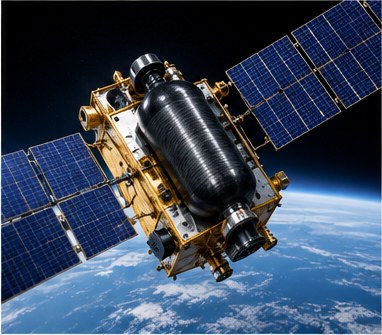
Where our aerospace work comes from
Our aerospace experience started on US programs. At Thiokol and United Technologies, Shaun Hogan was principal design engineer of the filament-wound rocket motor case that launched GPS satellites, and worked on the Peacekeeper and Titan 34D programs and on satellite propulsion motors.
That discipline, where every gram counts and every margin has to be shown, carries into all of our work. It is also why our commercial cylinder designs hold up: aerospace habits make a production line more reliable, and production thinking makes flight hardware buildable.
Aerospace heritage
Thiokol and United Technologies
Principal design engineer of the filament-wound motor case that launched GPS satellites; Peacekeeper and Titan 34D programs; satellite propulsion motors.
EDO Fiber Science
Director of Engineering, leading a team of 15 engineers and technicians on composite structures for aircraft, aerospace and wind energy.
COPV technology transfer
COPV technology training for space industry programs under Boeing offset agreements.
Satellite propellant tank design
Training, design and FEA for new satellite propellant tanks for a European space company.
Wichita State University
Delivered a two-day COPV training to the NIAR team covering Type 4 and Type 5 linerless vessels, filament winding and automated fiber placement, and lead an open COPV training at NIAR for engineers from any organization.
What we do for aerospace teams
Lightweight COPV design
Type 4 and Type 5 linerless vessels, laminate and dome design at the lowest fiber mass, FEA combined with micromechanics.
Qualification planning
Test matrices, burst and cycle margins, flaw tolerance and the design file that supports approval.
Winding and fiber placement process
Machine set-up, tension and bandwidth control, cure schedules and exotherm control in thick laminates.
Independent design review
A second set of eyes on a design, a test failure or a supplier before it costs a program schedule.
Failure analysis
Root cause of leaks, ruptures and test failures, from fractography to the manufacturing record.
Team training
Design, qualification and manufacturing courses taught on your product and your equipment.
How we work
Every engagement is run directly by our two principals, based in Colorado, USA. Tell us about your program and we will tell you plainly whether we are the right fit.