ARAGNA TECHExperience. Integrity. Clarity.

COPV training

COPV filament winding training.

Taught by the people who fixed the problems, and built around your product, your machine and your standards. The program follows the order a real cylinder program runs in: design the vessel, prove it to the standard, then build it the same way every shift.

Open session · Wichita, Kansas

Intro to COPV Design & Manufacturing: Hands-On Filament Winding Training.

Open to engineers from any organization. Design, qualification and manufacturing of composite pressure vessels, taught by Shaun Hogan and Alexis Dubois, PhD. Seats are limited, and the session goes ahead once enough participants have registered.

We have previously delivered a two-day COPV design curriculum to the NIAR team.

Dates
November 17 to 18, 2026 (two days)
Location
NIAR, Wichita State University, Wichita, KS
Registration
NIAR course page
Instructor explaining a composite pressure vessel to three engineers beside a filament winding machine
Engineer reviewing a finite-element stress visualization of a composite pressure vessel
Stage 1 of 3

Design & engineering

From concept to an optimized design at the lowest carbon fiber mass.

  • Laminate design and dome contour
  • Boss and polar boss geometry
  • Liner choice: aluminum, HDPE, PA-6, PA-12, PET, linerless Type 5
  • FEA combined with micromechanics
  • Burst and cycle life prediction
  • Winding pattern design in ComposiCAD
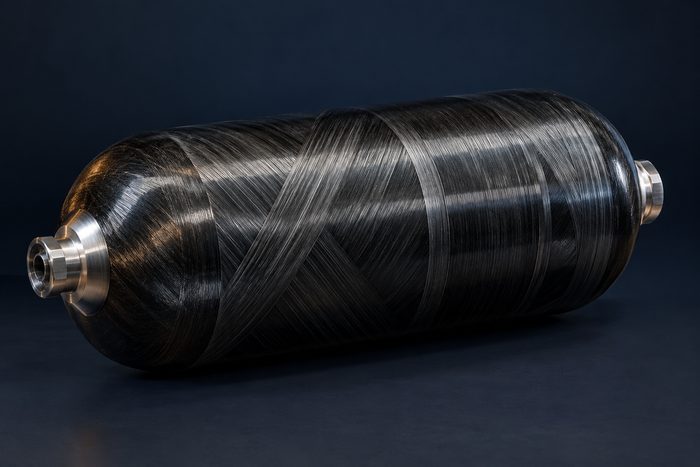
Composite overwrapped pressure vessel with metal bosses
Stage 2 of 3

Qualification & certification

Pick the right standard, plan the test matrix, pass the first time.

  • ISO 11119-3, ISO 19881, EN 12245, NGV2, ASME Section X, GB/T
  • US DOT special permits, Transport Canada, EU TPED and PED
  • Burst ratios and fiber stress ratios by fiber type
  • Cycling, permeation, bonfire, drop and flaw tolerance tests
  • Qualification test plan and design file
  • Working with third-party inspection agencies
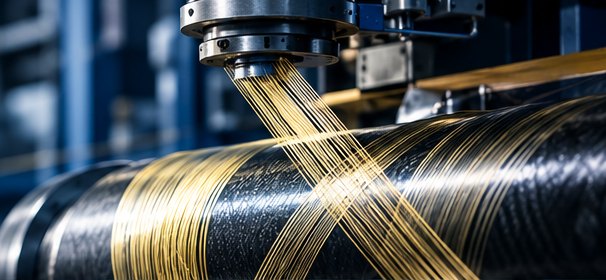
Filament winding head laying fiber tows on a cylinder
Stage 3 of 3

Manufacturing & process

Right process, right quality, every cylinder like the one that passed.

  • Machine set-up and calibration
  • Fiber tension and bandwidth control
  • Resin and tow selection, wet winding versus towpreg
  • Wrinkle and void avoidance
  • Cure schedule development and exotherm control
  • In-process and optical inspection
  • Troubleshooting and defect resolution

A complete line, step by step

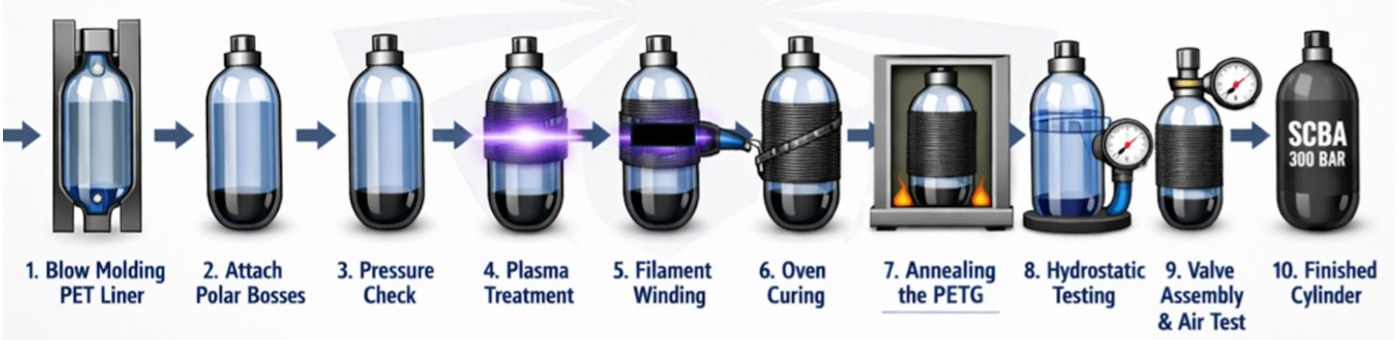
Example from our Type 4 SCBA module: a 300 bar breathing air cylinder on a PET liner, from blow molding to the finished, air-tested cylinder. Trainees walk each station and its failure modes.

Ten-step SCBA composite cylinder process: blow molding PET liner, attach polar bosses, pressure check, plasma treatment, filament winding, oven curing, annealing the PETG, hydrostatic testing, valve assembly and air test, finished cylinder

What your team gains

Better vessels. Greater efficiency.

  • 01Higher winding throughput and capacity
  • 02Lower scrap and rework
  • 03Reduced fiber mass and material cost
  • 04Fewer recurring test failures and higher yield
  • 05Stronger, lighter, more consistent vessels
Formats
ProgramLengthCovers
Intensive2 daysOne stage in depth, chosen for your team
Full program5 daysDesign, qualification and manufacturing end to end
Operator program1 to 4 weeksHands-on at your plant, on your machine and product
Remote series6 to 10 sessionsLive sessions with worked problems in between
Aluminum linersOn requestType 3 liners: forging, dome spinning, heat treating

Every participant receives the course workbook, a worked design example sized to your product class, and a certificate of completion.

Design & analysis engineersAll three stages, with design as the core.
Process & production engineersManufacturing stage plus process control.
Machine operators & techniciansTaught at the machine, on your product.
QA & inspection staffQualification plus in-process inspection.

Recognized industry educators. We delivered a two-day COPV design curriculum to the NIAR team at Wichita State, covering Type 5 linerless vessels, filament winding and machine operation, and we lead an open COPV training at NIAR for engineers from any organization. We are also expert users of ComposiCAD winding design software.

Plan a program

Questions

About our training.

Short answers. Ask us for the long ones.

How long does COPV filament winding training take?

A focused intensive runs 2 days. The full design, qualification and manufacturing program runs 5 days. Hands-on operator programs at your plant run 1 to 4 weeks depending on shifts and products.

Can you train on our own winding machine?

Yes, and we recommend it. We have specified, purchased and commissioned filament winding machines and work with the major machine builders, so we teach on the equipment your team will actually run.

Does the course prepare us for a specific standard?

We tailor the qualification stage to the standard you are working to, whether that is ISO 11119-3, ISO 19881, a US DOT special permit, EN 12245 or GB/T.